
Engineers Canada has achieved a significant milestone in its international mobility work, earning the maximum-possible six-year extension to its membership in the International Professional Engineers Agreement (IPEA) and the Asia-Pacific Economic Cooperation Engineering Agreement (APEC EA).
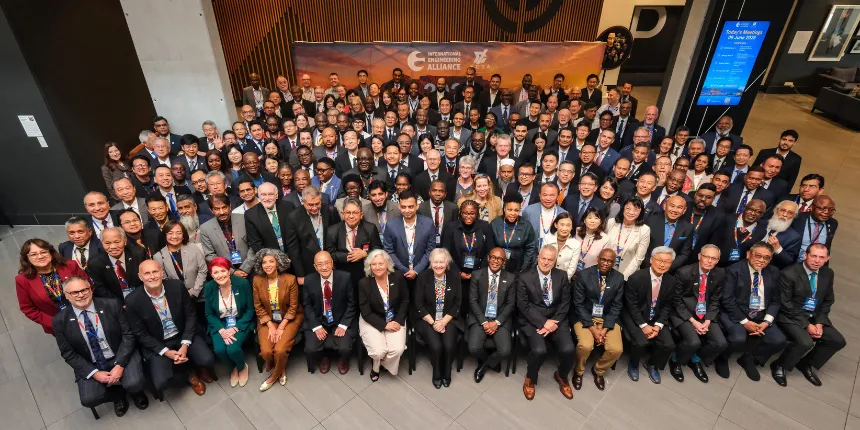
The extension was granted as the result of a vote from authorized agreement members during the annual meeting of the International Engineering Alliance (IEA), held in Cape Town, South Africa, from June 7 to 12, 2026. The meeting was attended by more than 200 delegates from 49 engineering organizations representing 39 countries. Canada was represented at the meeting by Engineers Canada President Darlene Spracklin-Reid, Chief Executive Officer Philip Rizcallah, Vice President, Regulatory Affairs, Trina Hubley, Chair of the Canadian Engineering Accreditation Board Julius Pataky, and Manager, Regulatory Research and International Mobility, Kyle Smith.
The IEA is a global collective of like-minded organizations focused on quality assurance in engineering education and professional competence. IEA members meet annually to review policies and procedures, consider reviews of participating organizations, and consider applications for membership.
The IEA governs and administers the IPEA and APEC EA, of which Engineers Canada is the Canadian signatory. These agreements recognize the substantial equivalence in professional competence in engineering and are intended to help streamline the review of professional credentials for engineers wishing to practise in another member country. Part of the quality assurance activities in maintaining membership status in these agreements involves periodic review by a panel of experts to ensure that the systems in place to recognize the required professional competence for independent international practice continually meet the requirements set forth by the IEA. The maximum possible extension to a country’s participation in the agreements following a review is six years.
In preparing for the review, Engineers Canada transitioned to using a new online system for managing obligations under the agreements related to international mobility and developed a new policy framework to guide practices. The review, conducted throughout the second half of 2025 and into early 2026, saw reviewers engaging with both Engineers Canada staff and the Association of Professional Engineers and Geoscientists of Alberta (APEGA)’s Board of Examiners. The outcome is the culmination of several years of focused work, and the six-year extension reflects strong confidence internationally in Canada’s systems for assessing professional engineering competence.
For engineers licensed in Canada looking to practise in another IEA member country, Engineers Canada offers the Engineers Canada Mobility Register as the means to earn the IntPE (Canada) and APEC Engineer (Canada) designations that enable recognition under these agreements.
Workshops were also held throughout the IEA meeting in Cape Town, including one by Engineers Canada’s Kyle Smith. His workshop focused on helping IEA agreement members navigate the complex process of driving regulatory and legislative change needed to recognize IntPE and APEC EA Engineer designations in their jurisdictions. Through guided group exercises and using a specific regulatory challenge in their own jurisdictions, participants identified key decision makers and influencers, mapped each actor's motivations, and selected strategic approaches to build support for change, leaving with a clear action plan. The workshop was extremely well-received, with member countries detailing how the suggestions surfaced in the workshop can be leveraged to improve IntPE and APEC EA recognition.
Engineers Canada will attend the next annual IEA meeting in 2027, and will prepare for the Washington Accord periodic review of Engineers Canada. The review will begin in late 2027 for decision at the 2028 IEA meeting.