
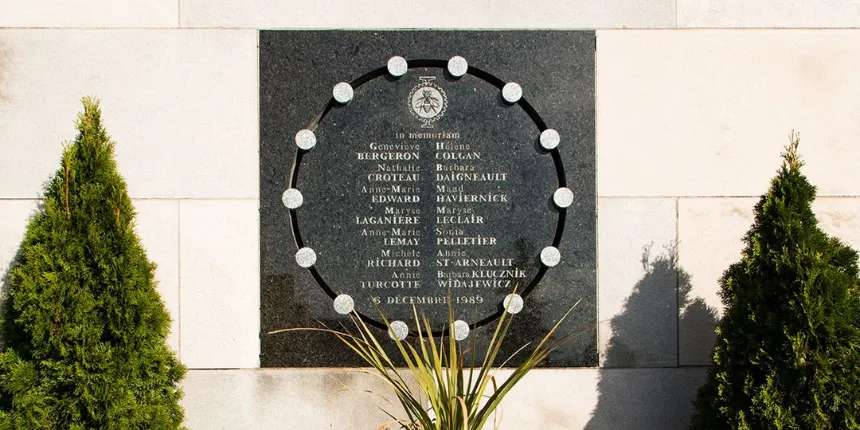
Each year on December 6, the engineering community remembers the 14 women murdered in an act of femicide at École Polytechnique in 1989. This act of gender-based violence remains a defining moment in our profession’s history, a reminder of the extreme consequences of misogyny and violence against women. Their loss continues to be felt across Canada and in the engineering community, and it underscores the urgent need for safe, inclusive spaces where everyone can thrive without fear.
On December 6, we remember:
Geneviève Bergeron, civil engineering student
Hélène Colgan, mechanical engineering student
Nathalie Croteau, mechanical engineering student
Barbara Daigneault, mechanical engineering student
Anne-Marie Edward, chemical engineering student
Maud Haviernick, materials engineering student
Barbara Klucznik-Widajewicz, nursing student
Maryse Laganière, budget clerk in the École Polytechnique's finance department
Maryse Leclair, materials engineering student
Anne-Marie Lemay, mechanical engineering student
Sonia Pelletier, mechanical engineering student
Michèle Richard, materials engineering student
Annie St-Arneault, mechanical engineering student
Annie Turcotte, materials engineering student
The anniversary of December 6 falls within the 16 Days of Activism Against Gender-based Violence, an international campaign that runs from November 25 to December 10. Gender-based violence continues to be an ongoing issue in our society, disproportionately impacting women and girls. The 16 Days of Activism also invites us to look closely at the everyday behaviours and systemic factors that continue to create unsafe or exclusionary environments in engineering. Engineers Canada has been highlighting some of these factors—and resources that can create safer spaces—on its social media during the 16 Days.
Gender-based violence does not begin with extreme acts; it often grows from patterns of disrespect, exclusion, and harm that go unaddressed. Microaggressions, for example, may seem subtle, but their cumulative impact can erode psychological safety and normalize behaviours that disproportionately harm women and gender-diverse people. Tools like Women in Consulting Engineering - Vancouver’s Microaggressions Action Plan offer practical guidance to help individuals and organizations recognize and interrupt these behaviours before they escalate.
Data helps us understand the scope—and urgency—of gender-based harassment and discrimination in engineering. To drive meaningful change, we need strong, transparent data that highlights patterns, surfaces barriers, and helps us understand where action is most needed. The Speak Out Revolution Dashboard provides global insights into patterns of workplace bullying and harassment, while in Canada, CCWESTT’s Gender Equality Report Card highlights how these issues continue to limit the participation and advancement of women and 2SLGBTQIA+ individuals in STEM. Together, these tools help industries, organizations, leaders, and individuals better understand the landscape and identify where interventions can make the most impact.
Preventing harm also means equipping people with the skills to act. Programs like the Ending Violence Association of BC’s Be More Than a Bystander, featured earlier this year at Engineers Canada’s 30 by 30 Conference, equips participants to intervene effectively to end violence, bullying, and harassment, and contribute to safer, more respectful workplaces. And this discussion from the 2023 30 by 30 Conference provides practical insights for workplace violence prevention from then-Canadian Women’s Foundation CEO, and current senator, Paulette Senior.
As we remember the women killed in 1989 at École Polytechnique, we honour their legacy through continued action: challenging harmful norms, supporting safe engineering spaces, and addressing the systemic factors that allow gender-based violence to persist. During the 16 Days of Activism—and throughout the year—we encourage engineers, employers, and partners across the profession to explore these resources and reflect on the role each of us plays in shaping engineering cultures where everyone is respected, supported, and safe.