
Contents
President’s message
Strategic direction 1: Realizing a stronger federation
Strategic direction 2: Realizing accreditation and academic assessments
Strategic direction 3: Realizing our role in sustainability
Strategic direction 4: Realizing an inclusive profession
Strategic direction 5: Realizing a fuller awareness of engineers
Core purpose 1: Accreditation
Core purpose 2: Regulator relationships
Core purpose 3: Services and tools
Core purpose 4: National programs
Core purpose 5: Advocating to the federal government
Core purpose 6: Researching, monitoring and advising
Core purpose 7: International mobility
Core Purpose 8: Promotion and outreach
Core Purpose 9: Equity, diversity, and inclusion
Core purpose 10: Protecting official marks
Financial statements
President’s message

This annual report marks the completion of the first year of Engineers Canada’s 2025–2029 strategic plan, Realizing Tomorrows. The plan sets a direction for how we will support regulators, strengthen the profession, and respond to the changing context in which engineers practise. It reflects a shared commitment to regulatory excellence, collaboration, and practical action as we move ideas into outcomes that matter for the profession and for the public interest.
In a period marked by ongoing change in the engineering profession and the broader societal context in which it operates, our work in 2025 reinforced the value of national coordination and thoughtful leadership.
A central theme of the year was strengthening our federation. Engineers Canada exists to support and convene Canada’s provincial and territorial engineering regulators and in 2025 we continued to invest in governance and collaboration that reflects this role. The Board launched a formal governance review, supported by external expertise and informed by regulators and interest holders across the system. This work is laying the groundwork for clearer roles, stronger decision-making, and a governance model that can support the organization well into the future.
Progress on accreditation and academic assessment was another significant focus. Building on the Futures of Engineering Accreditation (FEA) Path Forward Report, Engineers Canada has begun the transition from learning to implementation. Throughout the year, we worked with regulators, academic partners, and volunteers to build shared understanding of the recommended changes and to advance priority initiatives. At the same time, the Canadian Engineering Accreditation Board (CEAB) continued its core work, completing accreditation visits across the country and further strengthening the transparency and effectiveness of the system.
Creating a more inclusive profession remained a priority. The national 30 by 30 Conference, held in May, expanded the conversation beyond gender to address broader issues of representation and systemic change, with strong participation from across industry, academia, and regulation. We also initiated an Inclusivity Taskforce with regulator CEOs, continued work on employer benchmarks, and advanced a draft Truth and Reconciliation framework under the guidance of our Indigenous Advisory Committee.
Raising awareness of engineers and supporting pathways to licensure were also key areas of work. The Pathway to Engineering initiative continued to grow, reaching students and early career professionals through expanded resources, webinars, and targeted pilot programs. Meanwhile, we assessed the impact of recent marketing efforts and worked with regulators to plan a renewed, focused approach to public awareness.
On the sustainability front, Engineers Canada began developing policy statements to integrate such considerations into Board decision-making and initiated a scan of how similar associations and professions are incorporating environmental sustainability within their organizations.
None of this work would be possible without the dedication of our volunteers, the engagement of regulators, and the commitment of Engineers Canada staff. I am grateful for the professionalism and care they bring to this shared work.
As we look ahead, the progress made in 2025 provides a strong foundation. By continuing to work together, we can support a profession that serves the public interest, adapts to change, and reflects the diversity of the communities that engineers serve.
Sincerely,
John Van der Put, FEC, FGC (Hon.), P.Eng.
President
Engineers Canada
Strategic direction 1: Realizing a stronger federation

Engineers Canada is the national organization of the 12 provincial and territorial engineering regulators, which are its Members. The Members collectively approve Engineers Canada’s direction and exercise their authority through the Meeting of Members. Engineers Canada is governed by a Board of Directors, nominated and appointed by the Members, to provide ongoing direction and oversight in accordance with the organization’s bylaws.
This strategic direction seeks to strengthen our federation by exploring the development of a national process to select future areas of regulatory collaboration and harmonization, and enhancing the organization’s governance framework through a governance review. The review is centred on the Engineers Canada Board’s composition, competencies, reporting structure, voting procedures, and observers’ rights.
In 2025, the Board stood up a task force to oversee the governance review. The task force hired an external governance expert to conduct the governance review process. The consultant completed a first round of consultation with all 12 regulators, the Engineers Canada Board and chief executive officer, the Canadian Engineering Accreditation Board (CEAB), the Canadian Engineering Qualifications Board (CEQB), and governance staff to identify the issues related to our governance system. Results of the first round of consultations were discussed at a workshop with the presidents, chief executive officers, and the chairs of the CEAB and the CEQB in the fall. The consultant embarked on a second round of consultations to explore potential solutions to the identified issues at the end of 2025.
In 2026, the second round of consultation will be completed, and recommendations will be presented to the Engineers Canada Board and Members for approval.
Strategic direction 2: Realizing accreditation and academic assessments
Engineers Canada accredits engineering programs, on behalf of engineering regulators, so that applicants with an accredited degree meet the academic requirements for licensure. The purpose of this strategic direction is to build an improved accreditation system, support regulators in implementing a new national academic requirement for licensure, and develop a business case for a national academic intake process for applicants without a Canadian engineering degree accredited by the Canadian Engineering Accreditation Board (also referred to as non-CEAB applicants).
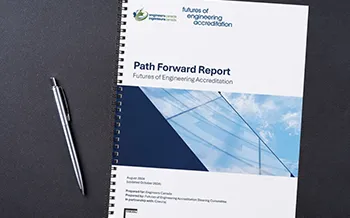
In 2025, we started to work on the implementation of the Futures of Engineering Accreditation (FEA) Path Forward Report. We held sessions to build knowledge about the implications of the report’s recommendations on the current accreditation system. Work is progressing toward implementing ten of the 18 recommendations.
The Realizing Accreditation and Academic Assessments (RAAA) Project has five streams and program management: the business case for the academic assessments for non-CEAB applicants, the Full Spectrum Competency Profile (FSCP) Pilot Study, outcome-focused accreditation, faculty licensure requirements and meaningful exposure to licensed professionals, and foundations components.
As part of the development of a business case to set a national intake process for the academic assessments of non-CEAB applicants, we completed, with the National Admission Officials Group, a review of commonalities in academic assessments among jurisdictions. We are in the process of sharing an external legal opinion that investigated what elements that potential intake process could have without changing regulators’ acts, regulations, and bylaws.
A program development consultant, with the FSCP Pilot Study’s Advisory Group, has written a report identifying the six competencies that will be developed for the first phase of the FSCP pilot study. Learnings from the development of those competencies and assessment processes will form the foundation for developing and validating a new, full FSCP framework in the second phase of piloting.
To move to an outcome-focused accreditation, we are in the process of determining the required approach and timeline.
The CEAB’s Policies and Procedures (P&P) Committee and Engineering Deans Canada’s (EDC’s) Deans Liaison Committee (DLC) have been working together to clarify the underlying purpose of the accreditation criteria related to faculty licensure requirements. The objective is to ensure that specific student outcomes result from substantial and meaningful engagement with licensed professional engineers, rather than being inferred through the counting of contact hours with licensed professionals involved in engineering education. Their joint purpose statement is guiding current deliberations on which accreditation criteria should be retained and/or revised. The proposed revisions to the criteria will be circulated for national consultation in 2026.
We are examining opportunities to increase industry involvement in the RAAA project and assess return on investment.
We will continue advancing these major developments within the accreditation system through 2026.
Strategic direction 3: Realizing our role in sustainability
Engineers are responsible for holding paramount the safety, health, and welfare of the public and the protection of the environment. Not only do engineers play a key role in sustainable development, but they also protect the public interest. Regulators establish the standards and requirements that govern engineers and engineering practice, including those related to sustainable development.
The United Nations’ 17 Sustainable Development Goals (UNSDGs) have been referenced by, and integrated within, the International Engineering Alliance’s Graduate Attributes and Professional Competencies Framework. They also serve as a basis for the six Canadian Engineering Grand Challenges (CEGCs) 2020-2030 that were identified by Engineering Deans Canada.
In 2025, Engineers Canada began developing policy statements to guide environmental sustainability considerations into the Board’s decision-making processes. We also completed a scan of how other similar organizations, including other professions, are incorporating environmental sustainability considerations within their national organizations.
In 2026, we will conduct a workshop of regulators and Board members to scope Engineers Canada’s national role in sustainability.
Strategic direction 4: Realizing an inclusive profession

To remain dynamic and growing, the engineering profession must ensure that solutions serve an increasingly diverse client base. Engineers must understand the impact of their practice on the various communities they serve.
To realize a truly inclusive engineering profession, we drive inclusiveness of women and embrace inclusion, diversity, equity, and accessibility (IDEA), recognizing the intersectionality of these identities. We partner with organizations and regulators to establish our role in moving IDEA forward in engineering. We will ourselves endeavour to become an IDEA employer of excellence.
Engineers Canada is leading a national movement to increase women and under-represented groups’ representation in engineering. More information is available in our National Membership Report.
On May 21, 2025, we held another successful national 30 by 30 Conference on the topic of Solutions and Accountability Towards an Inclusive Engineering Profession. The conference took the conversation about representation beyond gender to include other marginalized groups, focusing on the need for systemic change. The conference included presentations on the obstacles related to data collection, intersectionality in engineering, gender equity change, and what is next for the profession. For the first time, in addition to collaborating with the local regulator, the conference partnered with the Association for Consulting Engineering Companies British Columbia (ACEC-BC). The conference was successful, gathering over 400 attendees, surpassing the team’s representation targets from industry, academia, and regulation with over 40 per cent of the room identifying as men.
In collaboration with the Chief Executive Officers (CEO) Group, the CEOs of Canada’s engineering regulators, we initiated an Inclusivity Taskforce with a focus on equity, diversity, and inclusion in the profession. We also continued to advance work on the development of an engineering employer benchmark and community of practice with support from the Association of Consulting Engineering Companies–Canada (ACEC-Canada).
We continue to publish our monthly 30 by 30 Newsletter, to which you can subscribe here. We also worked with consultants to develop a draft Truth and Reconciliation Framework and Roadmap for Engineers Canada.
In 2026, we will continue to move work through our Inclusivity Taskforce for regulators, and our collaboration with ACEC-Canada to support employers’ engagement in our work to create a more welcoming and inclusive profession. We will be partnering with the Canadian Coalition for Women in Engineering Science, Trades and Technology (CCWESTT), as well as the Association for Professional Engineers and Geoscientists Alberta (APEGA), for our 30 by 30 Conference that will be taking place in Calgary on May 24, 2026, embedded within the CCWESTT Conference taking place from May 23-26.
We will also continue to provide national leadership to advance truth and reconciliation. Under the guidance of our Indigenous Advisory Committee, we will take a culturally sensitive approach that sets a foundation for truth before reconciliation, further develop our partnerships, and provide training and resources to our staff and volunteers.
Strategic direction 5: Realizing a fuller awareness of engineers
Engineers Canada supports engineering regulators by raising the profile of what engineers do and how they protect the public. The purpose of this strategic direction is to review the impact of our national marketing campaign and determine what Engineers Canada’s approach should be with respect to strengthening awareness and trust in the profession.
In 2025, we took stock of the successful two-year Building Tomorrows marketing campaign and, working with the chief executive officers of the 12 engineering regulators, decided that we will execute another, smaller, marketing campaign. We will be working with the National Communications Officials Group to develop the approach and messaging. We expect that this work will maintain the public momentum on the role of engineers in the public’s eye.
Work is also continuing with our Pathway to Engineering project, expanding it from an online portal to a suite of offerings to better support early career professionals on their path to licensure. In 2025, we continued attracting visitors to the portal, mostly engineering students and graduates, and expanded their knowledge of the licensure process. We also created a community of professionals who can support them on their journey. With provincial and territorial regulators, we hosted two webinars on the value of engineering licensure reaching more than 230 individuals. We piloted a licensure support initiative in Prince Edward Island, the Northwest Territories, and Nunavut to support women in obtaining their licence.
We have initiated Engineers in Leadership, an effort to better understand how engineers are represented on corporate and public bodies boards, gain insight on the dynamics of recruitment, and undertake targeted activities to strengthen their participation.
In 2026, we will potentially launch a targeted national marketing strategy with a focus determined with regulators. We will continue, through the Pathway to Engineering program, to improve the knowledge sharing and community building aspects of the platform, explore the role of mentorship, and expand our pilot program to additional provinces and territories. We will continue to host webinars to increase awareness of the licensure process across Canada. Finally, we will review recommendations from the Engineers in Leadership research project and develop tools to further advance the role of engineers in senior, strategic decision-making roles.
Core purpose 1: Accreditation
Accreditation is one of the core functions performed by Engineers Canada on behalf of the regulators. This review process is conducted at the request of higher education institutions (HEIs). As of the date of publication, there are 308 accredited engineering programs at 47 HEIs across Canada.
In 2025, the accreditation volunteers and staff were busy conducting visits to 19 institutions, representing 156 visitors and 96 programs. This was the second year of using Tandem, our new accreditation data management system.
We published the 2025 Accountability in Accreditation Report, the result of our annual program evaluation process, which measures the effectiveness, trustworthiness, transparency, and efficiency of the accreditation system. The results of this annual evaluation, based on feedback from interest holders, support decision making about improvements to be made to the accreditation system.
This year, we developed procedures for focused visits as well as program visits with satellite units and/or feeder institutions. We approved an extension of the evaluation date of the temporary exemption for students going on international exchanges from 2027 to 2029.
Also, we are in the process of finalizing revisions to automatically approve “Regulations for granting transfer credits” for CÉGEP students transferring to HEIs.
Finally, we completed the work on the CEAB’s Interpretive statement on curriculum content for options and multi-discipline programs, which is now included in the 2025 CEAB Accreditation Criteria and Procedures.
For the 2026-2027 visit cycle, we received 19 requests for accreditation, and preparation for this cycle is already underway.
Core purpose 2: Regulator relationships
Through our vision—Advance Canadian engineering through national collaboration—we frequently convene regulators on a variety of topics and support their work on several fronts. We support engineering regulators in working together to enhance internal and international mobility for engineers, engineering businesses, and applicants without an accredited degree from a Canada institution.
In 2025, regulators started to explore the feasibility and desirability of adopting a national continuing professional development (CPD) program. Provinces and territories are also continuing to work together on a new mobility application confirmation form to make it more seamless for applicants from one jurisdiction to transfer into another one. In addition, a review was initiated by Engineers Canada to better support regulators with the National Membership Database.
Finally, Engineers Canada, along with regulators, are also looking into the possibility that digital signature providers be consolidated at the national level.
In 2026, we will continue working on these initiatives and determine a national process to select future areas of collaboration and harmonization.
Core purpose 3: Services and tools

The Canadian Engineering Qualifications Board (CEQB) develops and maintains national papers, guidelines, and syllabi so that provincial and territorial regulators adopt consistent practices and support the seamless mobility of engineers, their organizations, as well as engineering applicants. The CEQB tackles admissions, practice of engineering, and discipline and enforcement matters, as well as emerging areas.
In 2025, the CEQB released a new Engineers Canada paper on emerging disciplines and revised the Regulator guideline on the academic assessment of non-CEAB applicants. Additionally, the CEQB completed examination syllabi reviews for naval and computer, as well as mining and mineral engineering. A key focus for the CEQB throughout the year was the promotion of its products at top regulatory conferences such as the Canadian Network of Agencies for Regulation and the Council Licensure, Enforcement and Regulation. The CEQB also focused on the development of quick guides, social media campaigns, and other resources for engineers.
Looking ahead, the CEQB will be drafting a new regulator guideline on the use of groundbreaking technologies in engineering. They will also revise the public Guideline on the practice of engineering in Canada as well as the public Guideline on qualified persons in demand-side legislation.
Core purpose 4: National programs
Engineers Canada offers services for professional engineers, geoscientists, their families, as well as participating organizations and their staff to support their work and their lives. Engineers Canada’s programs and services including personal insurance programs, corporate and business insurance, financial services and discount programs. The following sections highlight our activities and achievements for 2025.
Insurance Plans for engineers, geoscientists, their families, and pets
Home and auto insurance
Engineers Canada has partnered with TD Insurance to provide comprehensive and competitive home and auto insurance coverage.
Personal insurance
Through our partnership with Manulife, Engineers Canada offers the following insurance programs:
Term Life Insurance, Health and Dental Insurance, as well as Accident and Sickness Insurance.
Disability income replacement
Disability coverage provides for ill or injured engineers and geoscientists who are unable to work.
Major accident insurance
Engineers Canada offers, in partnership with Manulife, worldwide coverage that provides the funds to address the immediate costs of an accident.
Critical illness
This plan with Manulife covers diagnosis, which includes life-threatening conditions.
Business overhead
Offered through Manulife, this plan pays for eligible business expenses such as rent or mortgage payments, utilities, and employee salaries resulting from an injury or disability due to an illness or accident.
Pet insurance
In partnership with Petsecure, Engineers Canada provides a pet health insurance plan that covers accidents and illness diagnosis, x-rays, hospitalization, surgery, medication, emergency care, and dental care.
Professional liability and corporate insurances
Professional liability insurance
Through Victor Canada, Engineers Canada provides professional liability insurance, which protects employers, their employees, and their organization from claims and allegations of professional negligence. Coverage is for single practitioners, as well as multinational, multidisciplinary organizations.
Secondary professional liability insurance
A partnership with Hub International combined with insurance through AXA XL, protects individual professional engineers as they provide their professional services. This also includes whistleblower protection.
Corporate insurance
Corporate insurance includes directors and officers (D&O), errors and omissions (E&O), commercial crime, and cybersecurity.
National Employee Group Benefits Program
As part of National Employee Group Benefits Program, Engineers Canada, along with Manulife, supports engineering and geoscience regulators through employee benefit programs.
Financial services
Engineers Canada through the partnership with Canada Life provides savings plans for engineers, geoscientists, and regulator staff. The plan includes access to:
- Registered Retirement Savings Plans (RRSP)
- Non-Registered Retirement Savings Plans (NRSP)
- Tax-Free Savings Accounts (TFSA)
- Registered Retirement Income Funds (RRIF)
- Life Income Funds (LIF)
Discount programs
VIA Rail
With VIA Rail, Engineers Canada offers members a 7.5 per cent reduction in fee for their ticket and up to three additional tickets for those who join them on the trip, whether the trip is for business or leisure.
Car rental
Engineers Canada, in collaboration with Avis and Budget, provided 25 per cent off the posted rates for car rental.
Shipping
Engineers Canada, in partnership with UPS, provides a 50 per cent discount rate for domestic and international services.
In 2025, request for proposals were conducted for the Professional Liability and Corporate Insurance programs, Term Life and Personal Insurance programs, as well as the Financial Services programs to ensure we were offering the best programming and the most competitive pricing for our members. New consultants were chosen for each of the program areas after extensive analysis of the proposals.
In 2026, the Member Services team is looking to include new products in personal insurance in partnership with TD Insurance and Manulife, as well as financial insurance in collaboration with Canada Life. Additionally, the Member Services team will look to increase the variety of discount programs for members.
Core purpose 5: Advocating to the federal government

To influence national policy, Engineers Canada, on behalf of engineering regulators, works on federal government submissions, Issue Statements, National Position Statements, and other opportunities such as testifying before parliamentary and senate committees and participating in consultations.
National Position Statements are Engineers Canada’s official stance on public policy matters. In 2025, Engineers Canada revised two National Position Statements: Research, development, and innovation, and the Role of engineers in federal procurement of goods and services.
In 2025, the following government submissions were brought forward to the federal government:
-
2025 Pre-Budget Submission to the Department of Finance (pre-election)
In addition to National Position Statements and submissions, Engineers Canada also met with senior elected and public service officials, as well as other interest holder groups, to advocate for our national priorities on:
- Climate change adaptation and resilience
- The role of engineers in building and construction
- The licensure of engineers in the federal public service
- International trade agreement negotiations, including the Canada-United States-Mexico Agreement
- The importance of including engineers in efforts to speed up major projects across Canada
In 2026, Engineers Canada will continue to develop National Position Statements and government submissions as well as meet with senior government officials to advance topics of priority for engineering regulators.
Core purpose 6: Researching, monitoring and advising
We support regulators by providing them with a national view of strategic trends in regulatory and professional affairs across Canada. We help them foresee opportunities and threats that might take place within their provincial and territorial jurisdictions.
Throughout 2025, Engineers Canada further decentralized duties for researching, monitoring, and advising across the organization. The CEQB published a paper on emerging engineering disciplines and provided updated guidance on the academic assessment of non-CEAB applicants. The Public Affairs team also disseminated the impacts of Bill C-5 on the engineering profession, commented on Canada’s leadership in artificial intelligence, and completed an environmental scan of sustainable development and environmental practices in place within similar organizations and professions.
In 2026, we will continue to undertake research and advising activities.
Core purpose 7: International mobility
Engineers Canada is active on the international stage to facilitate the mobility of engineers and applicants from other countries wishing to practise in Canada and vice-versa.
We are signatories to many bilateral and multilateral agreements on behalf of the engineering regulators.
We are a member of the World Federation of Engineering Organizations (WFEO) and the International Engineering Alliance (IEA). With respect to the latter, Engineers Canada administers the public Engineers Canada Mobility Register, a service offered to individuals that have met the requirements for using the IntPE (Canada) and APEC Engineer designations. In 2025, 234 new registrants were added to the Mobility Register.
In 2025, Engineers Canada underwent a scheduled review of its alignment with the requirements of the IEA Professional Competence Agreements. Results of the review will be considered and voted on at the annual IEA meeting in June 2026.
Engineers Canada also maintains the International Institutions and Degrees Database (IIDD), a database for regulators that highlights the degrees offered at various institutions internationally, as well as membership to the international agreements. In 2025, the IIDD was viewed 3,976 times, a 156 per cent increase since 2022 when it was launched. An external party was also hired to perform a review of current processes and offer improvement recommendations.
International applicants can also access information on the Canadian licensure process on EngineerHere.ca. On that portal, we share information on the Canadian engineering licensure process and on our regulatory system. Applicants can view the information in Arabic, Bengali, Chinese (Traditional), Chinese (Simplified), English, Farsi, French, Hindi, Spanish, Tagalog, and Urdu.
The IIDD findings identified during the 2025 process review will be prioritized, with select initiatives slated for implementation in 2026. Additionally, Engineers Canada will consider potential enhancements to the Mobility Register.
Core Purpose 8: Promotion and outreach
Engineers Canada sparks interest in kindergarten to grade 12 students in becoming the next generation of engineers. Over the last two years, we have refined our career awareness strategy to serve as a backbone organization that enables similarly-focused organizations to reduce barriers preventing diverse youth from pursuing a career in engineering.
In 2025, we launched the Forward Engineering Collective, a group of similar-minded organizations that are building a more inclusive, connected, and visible future for engineering learning in Canada. Through this new initiative, we anticipate increasing our reach from 5,000 to over two million youth annually. More information about this initiative can be found here.

We also continue to support the Canadian Federation of Engineering Students (CFES) and EngiQueers Canada. We hosted the CFES’ annual leadership transition meeting in our offices, offered two mentorship sessions with the CFES’ national leadership teams, and have a long-standing Memorandum of Understanding that outline our commitments and collaborations throughout the years.
National Engineering Month
For over three decades, Engineers Canada has been leading National Engineering Month (NEM), Canada’s largest celebration of engineering. In 2025, we launched a new theme—Engineers Open Doors—which encouraged the public to see engineers as innovative leaders that bring people together and inspire. As we celebrated NEM 2025, we collaborated with Engineering Deans Canada and the Corporation of the Seven Wardens to mark the 100th anniversary of the Calling of an Engineer. NEM received more than 4.7 million impressions on social media. In 2026, we will continue with our Engineers Open Doors theme to engage engineering employers, organizations, academia, and individual engineers.
Engineers Canada Awards
Engineers Canada also celebrates the achievements of engineers and engineering students who are advancing the engineering profession and improving the lives of Canadians and others around the world. The 2025 award recipients were:
- Georges Kaddoum, PhD, P.Eng. – Gold Medal Award
- Angus McLean English, P.Eng. – Meritorious Service Award for Professional Service
- Sheliza Kassam, P.Eng. – Meritorious Service Award for Community Service
- Brian Frank, PhD, P.Eng. – Medal for Distinction in Engineering Education
- Kim Jones, PhD, P.Eng. (LEL) – Award for the Support of Women in the Engineering Profession
- Neil Mitra – Gold Medal Student Award

Learn more about our 2025 award recipients.
Engineers Canada Scholarships
Engineers Canada offers three types of scholarships, one for undergraduate students and two for graduate students. The recipients of the 2025 scholarships were:
Engineers Canada-TD Insurance Meloche Monnex Scholarships ($7,500)
- Nerissa Mulligan, M.A.Sc., MEd, P.Eng.
- Véronica Romero Rosales, ing.
Engineers Canada–Manulife Scholarships ($12,500)
- Majdi Flah, M.E.Sc., P.Eng.
- Mahdi Ghiasi, M.Sc., M.Eng., P.Eng.
- Emilie Pellerin, M. Sc. A., P.Eng.
Engineers Canada Leadership Scholarship ($4,000)
- Lauren Altomare
- Dante Capobianco
- Kalena McCloskey
- Ethan Nabuurs
- Amber Quo
- Muhammed Shareef
- Najma Sultani
- Sydney Yott
Learn more about our 2025 scholarship recipients.
Fellows of Engineers Canada
In 2025, the following individuals received an Engineers Canada fellowship for their noteworthy service to the engineering profession through their work with either Engineers Canada or the provincial and territorial engineering regulators:
Engineers Canada
Shelley Ford, FEC (Hon.)
Brent Gibson, FEC (Hon.)
Ivan Ntale, FEC (Hon.)
Adam Rodrigues, FEC (Hon.)
Heidi Theelen, FEC (Hon.)
Association of Professional Engineers and Geoscientists of Alberta (APEGA)
Mona Alkhatib, FEC, P.Eng.
Sidney Chan, FEC, P.Eng.
Ahmad Changizi, FEC, P.Eng.
David Franko, FEC, P.Eng.
Rada Geddes, FEC, P.Eng.
Lisa Hall, FEC, P.Eng.
Lorna Harron, FEC, P.Eng.
Sheliza Kassam, FEC, P.Eng.
Christopher Lenzin, FEC, P.Eng.
Dale Sahota, FEC, P.Eng.
Venkata Vemana, FEC, P.Eng.
Engineers and Geoscientists British Columbia
Angus McLean English, FEC, P. Eng.
Engineers and Geoscientists New Brunswick
Tammy Lamey, FEC, P.Eng.
Engineers Geoscientists Manitoba
David Amorim, FEC, P.Eng.
James Ashdown, FEC, P.Eng.
Jeffrey Bell, FEC, P.Eng.
Ryan Bernier, FEC, P.Eng.
Jason Bouchard, FEC, P.Eng.
Adam Coolidge, FEC, P.Eng.
Nelson Ferreira, FEC, P.Eng.
John Fox, FEC, P.Eng. (SM)
Andrew Gies, FEC, P.Eng.
Gordon Goldsborough, FEC (Hon.)
Fiona Hillier, FEC (Hon.)
Ryan Johnston, FEC, P.Eng.
Kyle Lenton, FEC, P.Eng.
Alan Margolese, FEC, P.Eng.
Cameron Mazurek, FEC, P.Eng.
Matthew Singer, FEC, P.Eng.
Phaedra Taiarol, FEC, P.Eng.
Christopher Trenholm, FEC, P.Eng.
Danielle Unett, FEC (Hon.)
Diana Vander Aa, FEC (Hon.)
Ian Wiebe, FEC (Hon.)
Engineers Nova Scotia
Browren Allard, FEC, P.Eng.
Kevin Bezanson, FEC, P.Eng.
David Cochrane, FEC,P.Eng.
Alexander de Sousa, FEC P.Eng.
Sarah Jane Dooley, FEC (Hon.)
Craig Lake, FEC P.Eng
Helen Langille, FEC, P.Eng.
Dharminderpal S. Mann, FEC, P.Eng.
Darrell Marsh, FEC, P.Eng.
Keith McKeen, FEC P.Eng.
Debra McLellan, FEC, P.Eng.
Sue Molloy, FEC, P.Eng.
Lawrence Murphy, FEC, P.Eng.
Donald Ross, FEC, P.Eng.
Holly Sampson, FEC, P.Eng.
Engineers PEI
Marianne LeBlanc, FEC, P.Eng.
Engineers Yukon
Kirsten Hogan, FEC, P.Eng.
Ordre des ingénieurs du Québec (OIQ)
François Deslauriers, FIC, ing.
Éric Germain, FIC, ing.
Georges Kaddoum, FEC, P.Eng.
Laurent B. Mondou, FIC, ing.
Professional Engineers Ontario (PEO)
Salman Basit, FEC, P.Eng.
Axar Bhavsar, FEC, P.Eng.
David Boogaart, FEC, P.Eng.
Albena Bukurova, FEC, P.Eng.
Savio De Souza, FEC, P.Eng.
Fereydoon Diba, FEC, P.Eng.
Ayman El Ansary, FEC, P.Eng.
Ron Finnigan, FEC, P.Eng.
Helder Fleury Pinheiro, FEC, P.Eng.
Brian Frank, FEC, P.Eng.
Johanna Friend, FEC, P.Eng.
Gil Galang, FEC, P.Eng.
Shinta Gragossian, FEC, P.Eng.
Jason Gubbels, FEC, P.Eng.
Amit Gupta, FEC, P.Eng.
William Haklander, FEC, P.Eng.
Mohamed Hamed, FEC, P.Eng.
Sen Hu, FEC, P.Eng
David Jackowski, FEC, P.Eng.
Torben Jensen, FEC.P.Eng.
Kim Jones, FEC, P.Eng. (limited licence)
Daniel Martis, FEC, P.Eng.
Mirsad Mulaosmanovic, FEC, P.Eng.
Franz Newland, FEC, P.Eng.
Pankaj Panchal, FEC, P.Eng.
Rishi Poddar, FEC, P.Eng.
Stephen Saxton, FEC, P.Eng.
James Tait, FEC, P.Eng.
George (Zheng Hong) Zhu, FEC, P.Eng.
Core Purpose 9: Equity, diversity, and inclusion
Engineers Canada works with key organizations to make engineering inclusive of women, Indigenous peoples, and marginalized groups. Our partners include provincial and territorial engineering regulators, engineers, employers, HEIs, similar-focused organizations, and engineering students. Collectively, we want the engineering profession to reflect the demographics of Canadian society and continue to meet the needs of the Canadian economy.
To advance an increased representation and inclusion of under-represented voices, we collaborate with partners such as Black Engineers of Canada, EngiQueers Canada, and CCWESTT.
We also support Indigenous Reconciliation through our work with the Canadian Indigenous Advisory Council and American Indian Science and Engineering Society-Advancing Indigenous People in STEM (science, technology, engineering and mathematics).
This year, we partnered with a consulting firm to improve how we measure progress toward a more inclusive and welcoming profession.
In 2026, we will continue this collaboration to define key success measures to create a national baseline, evaluate progress in addressing known barriers, and strengthen decision-making around initiatives and resource allocation.
Core purpose 10: Protecting official marks
Engineers Canada is the owner of an official mark for each of the following professional engineering designations:
- ENGINEER
- ENGINEERING
- CONSULTING ENGINEER
- PROFESSIONAL ENGINEER
- P.ENG.
- GÉNIE
- INGÉNIERIE
- INGÉNIEUR CONSEIL
- INGÉNIEUR
- ING.
In 2025, Engineers Canada consented to about 47 requests for federal registration, enabling the use of official marks owned by Engineers Canada, in their corporate name.
Financial statements
Download the 2025 summary financial statements.