

Canada’s engineering programs continue to show growth in both enrolment and degrees awarded, according to the most-recent edition of Engineers Canada’s report, Engineers for Tomorrow: Trends in Engineering Enrolment and Degrees Awarded 2018-2024. The report provides data about undergraduate and graduate enrolment and degrees awarded, including the number of female-identifying, international, and Indigenous students.
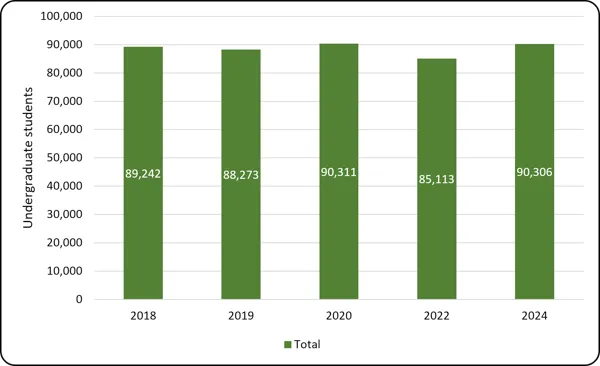
Based on data submitted by 43 higher education institutions with engineering programs accredited by the Canadian Engineering Accreditation Board (CEAB), undergraduate student enrolment totaled 90,306 in 2024, which is a 6.0 per cent increase from the last report in 2022, and a 1.0 per cent increase since 2018. The report finds the highest enrolment in mechanical, civil, and electrical engineering disciplines, while the computer and environmental engineering disciplines accounted for the largest growth since 2022.
Figure 1: Undergraduate enrolment, 2018-2024
Likewise, the report found that the number of engineering degrees awarded also continues to increase, with a total of 17,976 undergraduate degrees awarded in 2024. This aligns with an average annual increase of 2.7 per cent for the period of 2018 to 2024. The mechanical, civil, and electrical engineering disciplines awarded the highest number of undergraduate degrees in 2024, while the computer and software engineering disciplines demonstrated the greatest growth in degrees awarded since 2022 and 2018, respectively.
At the postgraduate level, the report found that enrolment totalled 35,150 in 2024, a 16.1 per cent increase from 2022, and a 36.1 per cent increase from 2018, which results in an 8.1 per cent annual growth rate. In 2024, there was a total of 12,754 master’s and 1,887 doctorate of engineering degrees awarded, making a combined total of 14,641 postgraduate degrees. This corresponds to a cumulative growth of 64.3 per cent in master’s degrees awarded and 19.9 per cent in doctoral degrees awarded since 2018.
Female-identifying, international, and Indigenous enrolment and degrees awarded
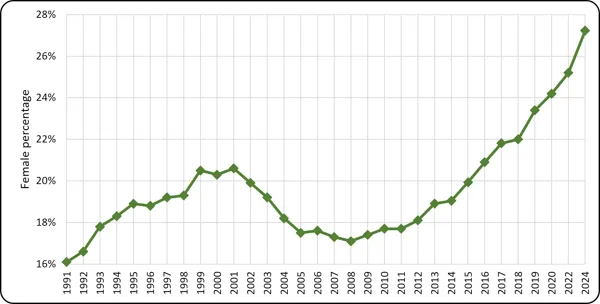
Engineers for Tomorrow also reports on female-identifying, international, and Indigenous enrolment and degrees awarded. Female-identified undergraduate enrolment remained above 25 per cent in 2024, with a 2.0 per cent increase to 27.2 per cent in 2024, from 25.2 per cent in 2022. Female-identifying students accounted for one quarter of all undergraduate degrees awarded in 2024, an increase of 12.3 per cent since 2022, and 28.8 per cent since 2018. The disciplines with the highest proportion of female-identified students enrolled in 2024 were biosystems, chemical, and geological engineering, while software, computer, and biosystems engineering have witnessed the most growth over the past five years, rising 123.3 per cent, 85.5 per cent, and 47.7 per cent, respectively, since 2018.
Figure 2: Female-identifying undergraduate enrolment, 1991-2024
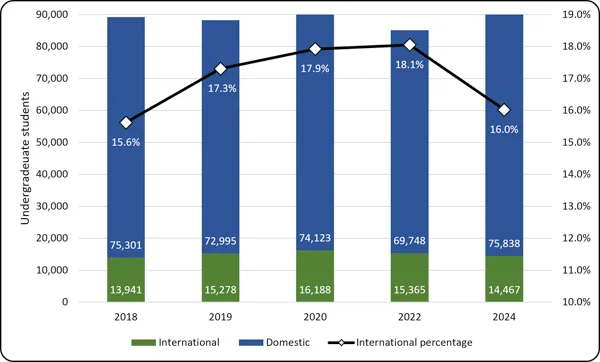
On the other hand, the percentage of international students enrolled in Canadian undergraduate engineering programs has decreased since 2022. International students accounted for 16.0 per cent of total undergraduate enrolment in 2024, an increase of 2.6 per cent since 2018, but a decrease of 11.3 per cent since the last report in 2022. The proportion of undergraduate degrees awarded to international students however did increase by 13.5 per cent since 2018, and by 2.1 per cent since 2022, to 16.6 per cent.
Figure 3: International and domestic enrolment, 2018-2024
Of the 43 institutions that provided data for the report, 21 provided information about Indigenous student enrolment and degrees awarded. Despite the overall growth across undergraduate and postgraduate studies, the representation of Indigenous students remains critically low, with only 0.7 per cent of engineering undergraduates identifying as Indigenous.
Read the full Engineers for Tomorrow report on the Engineers Canada website for detailed national, provincial, and discipline-level data.