
Data for 2024
1. Summary
Engineers Canada’s annual National Membership Report collects information from the provincial and territorial engineering regulators about their membership in order to paint a picture of the engineering profession in Canada. The 2025 report captures data from January 1, 2024, to December 31, 2024. Engineering members are categorized based on the definition of practice in each jurisdiction. Please find here all data tables associated with this report.
Overall, there was a moderate increase in licensing and membership in 2024.
Sex identifiers have historically been limited to “male” and “female” in the survey of national membership and in the surveys by many of our provincial and territorial regulators of their membership. We use “female-identifying” to describe participants who selected female, and “male-identifying” to describe participants who selected male, to be as literal as possible, to limit the assumptions between sex and gender identifiers, and to acknowledge the gender diversity that exists within these sex identities.
Note also that when surveying members about their sex and/or gender identifiers, respondents have the option to select “prefer not to say.” Therefore, throughout this report, when calculating the percentages of female-identifying and male-identifying engineers in the profession, this calculation excludes those individuals who responded ‘rather not say’ from calculation as we have no indication of their gender or sex identity.
It should also be noted that each regulator collects and stores membership data according to their internal policies, which may vary nationally.
Acknowledgements
Engineers Canada would like to thank and recognize the contributions of several staff who helped make this report possible including: Katharine Burke, Vivian Qian, Laura Paul, P.Eng., Kim Bouffard, Shelley Ford, and Jeanette Southwood, P.Eng. We would also like to thank Lili El-Tawil, for the French translation of this report, and Matthew Kulka for his work on the presentation of this report.
2. Growth in the engineering profession
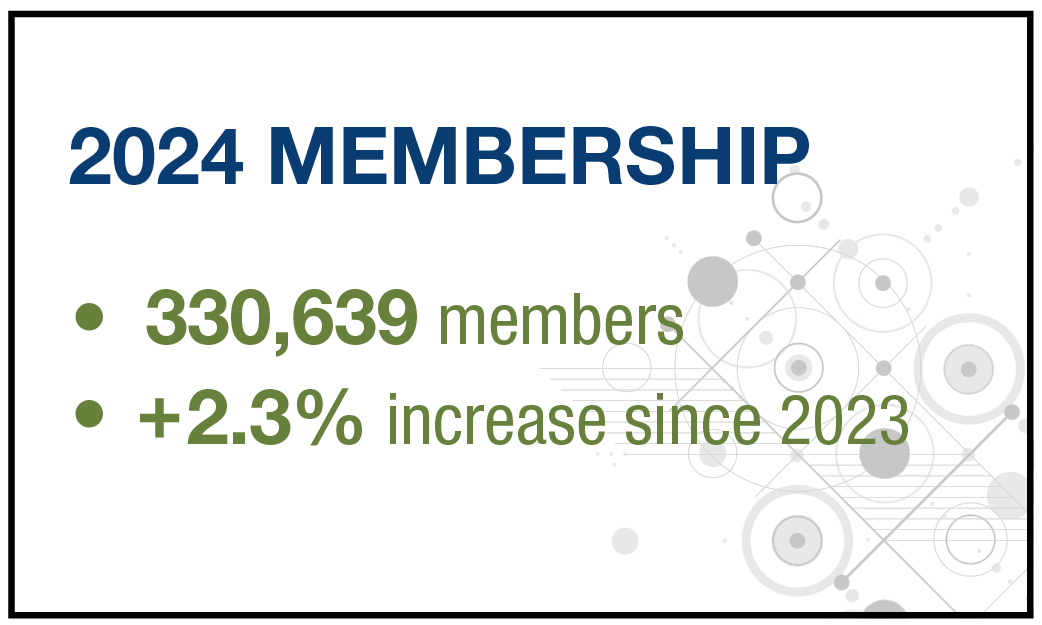
Membership in the provincial and territorial regulators increased moderately from 2023 to 2024. There were 330,639 members[1] as of December 31, 2024, across the 12 engineering regulators comprising the national total membership (see Table 1). This is an increase of 7,279 members[2]. In 2024, the largest growth in numbers was seen in Quebec (3,212 more members), and the greatest decline was seen in Ontario (1,223 fewer members).
3. Newly licensed engineers
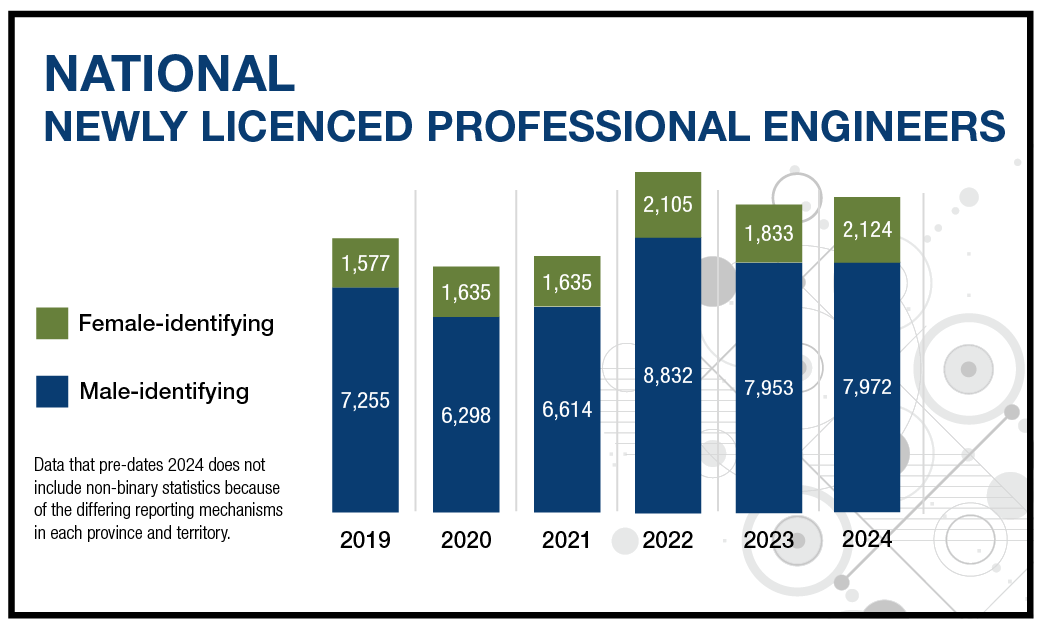
To understand the future of the profession, we track the number of newly licensed engineers[3] each year. There were 10,246 newly licensed engineers in 2024, with the largest number (3,537 engineers) obtaining their licence through Professional Engineers Ontario (PEO) (see Table 2).
For the ten-year trend in newly licensed engineers (2014 to 2024) see Table 3.
Further analysis of the pathway to licensure is captured in the section, ‘Sex representation in engineering.’
4. Engineers-in-training
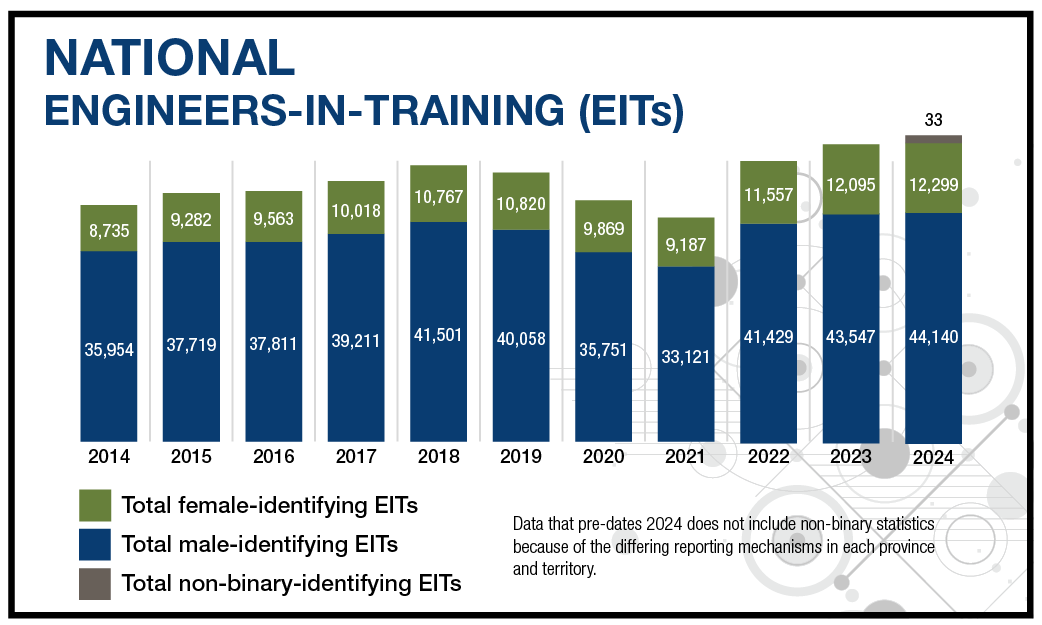
The number of engineers-in-training (EITs) increased slightly between 2023 and 2024, by 859 members. The number of male- and female-identifying EITs increased.
See Table 4 for the national EIT data from 2014 to 2024.
Further analysis of female-identifying EIT’s is captured in the section, ‘Sex representation in engineering.’
5. Sex representation in engineering
Note: When surveying members about their sex and/or gender identifiers, respondents have the option to select “prefer not to say.” Therefore, throughout this report, when calculating the percentages of female-identifying and male-identifying engineers in the profession, this calculation excludes those individuals who responded ‘rather not say’ from calculation as we have no indication of their gender or sex identity.
There are 52,103 female-identifying engineering members, representing 15.8 per cent of total national membership in 2024 (a percentage that increased from 15.4 per cent in 2023).[4] This is an increase of 2,177 members who are female-identifying between 2023 and 2024.
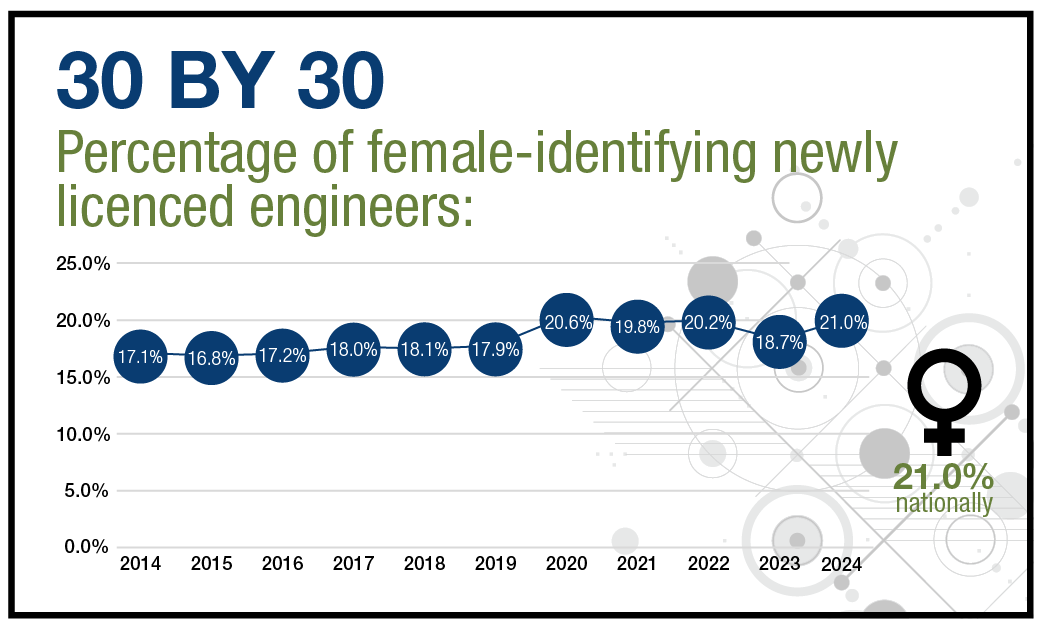
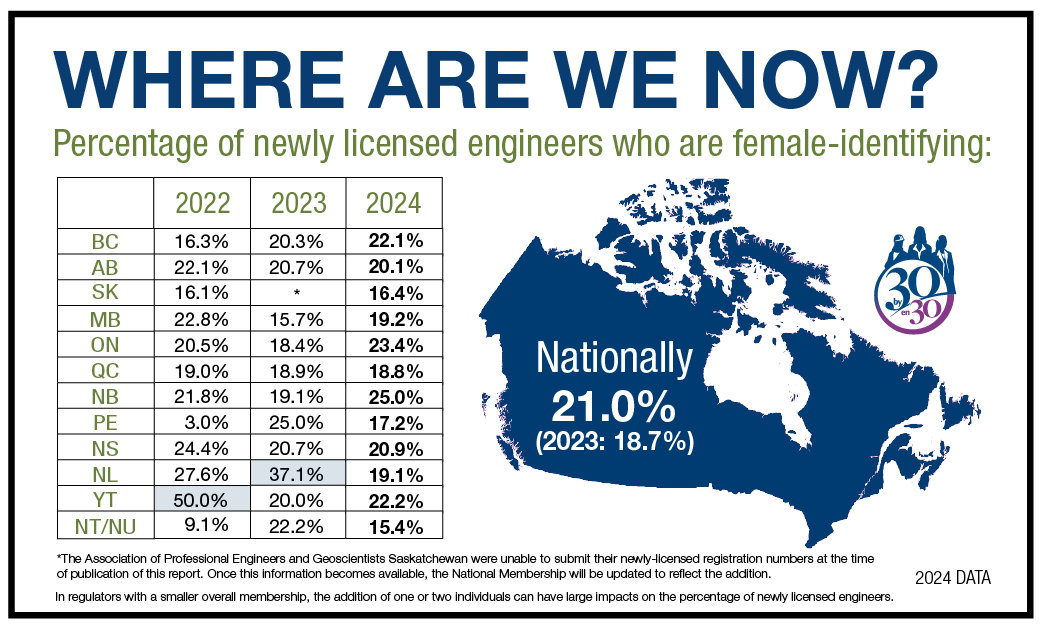
Engineers Canada and the regulators have been tracking the number of newly licensed female-identifying engineers since 2014, as part of the 30 by 30 initiative. In 2015, Engineers Canada launched the 30 by 30 initiative with support from the provincial and territorial regulators. 30 by 30 is a commitment to increasing the proportion of newly licensed engineers who are women to 30 per cent by 2030.
This is an important metric for tracking the impact of programs that support gender equity in engineering, since it marks a career milestone for women in their early careers, post-graduation from an accredited program, or for internationally trained engineers entering the Canadian job market.
Year over year, more female-identifying individuals are entering the profession. The total number of female-identifying individuals obtaining their licence in 2024 increased substantially by 291 engineers from the previous year. At the same time, more male-identifying engineers are also joining the profession, with the proportion of female-identifying engineers accounting for 21.0 per cent of newly licensed engineers in Canada in 2024 (see Table 2), which is an increase from 18.7 per cent in 2023.
The largest increase, by region, of newly licensed female-identifying engineers between 2023 and 2024 occurred in British Columbia (218 to 250).
The number of female-identifying EITs increased in 2024 by 204 members, with the overall proportion slightly increasing to 21.8 per cent in 2024 from 21.7 per cent in 2023. See Table 4 for the full breakdown of male- and female-identifying EITs.
Engineering student membership saw an increase in female-identifying members. The representation of engineering student members who identify as female increased from 25.0 per cent to 25.8 per cent between 2023 and 2024.
More data and information about gender representation at Canadian Engineering Accreditation Board (CEAB)-accredited engineering programs can be found in Engineers Canada’s Enrolment and Degrees Awarded Report.
Endnotes
[1] The category, Members, includes Practising P.Eng.’s (exclusive), Temporary License Holders, License to Practise Holders, Restricted License Holders, Non-Practising P.Eng.’s, Life Members and Engineers-in-Training. It does not include students.
[2] Engineers Canada, 2024. “2024 National Membership Information.” Engineers Canada, Ottawa, Canada. Available: https://engineerscanada.ca/reports/national-membership-report/2024-national-membership-information
[3] The category, Newly Licensed, includes individuals licensed as Professional Engineers for the first time that are Canadian Engineering Accreditation Board trained, Internationally trained, or have obtained their license by some other route. It does not include interprovincial mobility applicants.
[4] Sex and gender definition: Sex identifiers have historically been limited to ‘male’ and ‘female’ in the survey of national membership. We use “female-identifying” to describe participants who selected female, and “male-identifying” to describe participants who selected male, be as literal as possible, to limit the assumptions between sex and gender identifiers, and to acknowledge the gender diversity that exists within these sex identities.
[5] Engineers Canada, 2023. “Canadian engineers for tomorrow,” Engineers Canada, Ottawa, Canada. Available: https://engineerscanada.ca/reports/enrolment-and-degrees-awarded-report